

The word Walnut derived from theLatin word nux Gallica
The word Walnut derived from theLatin word nux Gallica
The Wanut is species of tree native to the region stretching from the Balkans eastward to the Himalayas and Southwest China. The largest forests are in Kirgyzstan, where trees occur in extensive, nearly pure Walnut forests at 1000-2000 m altitude notably at Arslanbob in Jalal-Abad Province.
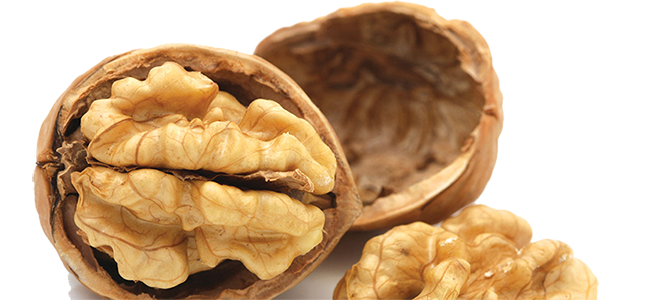
Walnut is a large deciduous tree attaining heights of 25-35 m, and a trunk up to 2 m diameter, commonly with a short trunk and broad crown, though taller and narrower in dense forest competition. It is a light-demanding species, requiring full sun to grow well. The whole fruit, including the husk, falls in autumn. The seed is large with a relatively thin shell and edible with rich flavor.
Persian Nut
In the fourth century B.C, Alexander the Great introduced this “Persian Nut” in Macedonian and Greek ancestral forms with lateral fruiting from Central Asia.They hybridized with terminal-bearing forms to give lateral bearing trees with larger fruit. These lateral-bearers were spread in Southern Europe and Northern Africa by Romans.
China Producer
China was the World’s largest producer of walnut seeds. The other major producers were United States, Iran, Turkey, Ukraine, Mexico, Romania, India, France and Chile.
Walnuts
Walnuts are a nutrient-dense food: 100 grams of walnuts contain 15.2 grams of protein, 65.2 grams of fat and 6.7 grams of dietary fiber.